
Growth Mindset Book PDF: A Comprehensive Guide
Discover a wealth of resources! Explore downloadable PDFs, including titles from Carol Dweck and Mindset Works, unlocking personal and professional development.
What is a Growth Mindset?
A growth mindset, popularized by Carol S. Dweck’s research, centers on the belief that abilities and intelligence aren’t fixed traits. Instead, they can be developed through dedication, hard work, and learning from experiences – a core tenet explored extensively in available growth mindset book PDFs.
This contrasts sharply with a “fixed mindset,” where individuals believe their qualities are innate and unchangeable. Embracing a growth mindset isn’t simply about positive thinking; it’s about recognizing that challenges are opportunities for growth, setbacks are learning experiences, and effort is the path to mastery.

The World Economic Forum’s reports (2025-2026) implicitly support this, highlighting the need for continuous adaptation and skill development in the “new economy” driven by AI and rapid change. PDF resources can help individuals cultivate this essential perspective, fostering resilience and a proactive approach to personal and professional evolution.
The Core Principles of a Growth Mindset
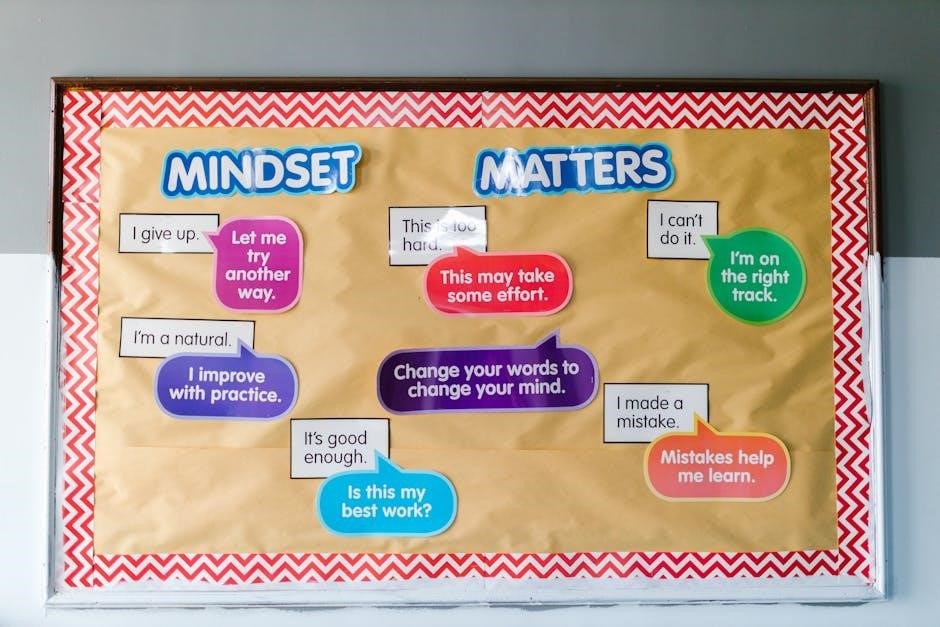
Central to a growth mindset are several key principles, often detailed within growth mindset book PDFs. These include embracing challenges, viewing failures as learning opportunities, valuing effort over talent, and being inspired by the success of others. It’s about believing in the power of “yet” – acknowledging current limitations while maintaining faith in future improvement.
Furthermore, a growth mindset encourages a focus on the process of learning rather than solely on the outcome. This aligns with the World Economic Forum’s emphasis on continuous skill development, particularly in areas like AI and fintech, as highlighted in their 2025-2026 reports.
PDF resources often emphasize that cultivating a growth mindset requires conscious effort and a willingness to step outside one’s comfort zone, fostering adaptability in a rapidly evolving world.
Benefits of Adopting a Growth Mindset

Adopting a growth mindset, as explored in numerous growth mindset book PDFs, yields significant advantages. Individuals experience increased resilience, enhanced motivation, and a greater willingness to embrace challenges – crucial for navigating the “new economy” detailed in World Economic Forum reports (2025-2026).
These benefits translate to improved performance in both personal and professional spheres. The ability to learn from setbacks, a core tenet of this mindset, is particularly valuable given the accelerating pace of change driven by AI and fintech innovation.
PDF resources consistently demonstrate that a growth mindset fosters continuous improvement, aligning perfectly with the need for step-change productivity and adaptability highlighted by the Forum’s findings.
Popular Growth Mindset Books Available as PDFs
Numerous growth mindset book PDFs are readily accessible, offering pathways to personal and professional transformation. “Mindset: The New Psychology of Success” by Carol S. Dweck remains a cornerstone, frequently available in digital format, providing foundational principles.
“Growth Mindset Coach” by Mindset Works is another popular choice, often found as a downloadable PDF, geared towards practical application and coaching techniques. These resources align with the World Economic Forum’s emphasis on skills development for the evolving job market (2025-2026).
Exploring these PDFs allows individuals to internalize strategies for embracing challenges and fostering a culture of continuous learning, essential for navigating the complexities of the new economy and leveraging AI for growth.
“Mindset: The New Psychology of Success” by Carol S. Dweck
Carol S. Dweck’s seminal work, frequently available as a PDF, details the contrasting mindsets – fixed and growth – and their profound impact on achievement. The book explores how believing abilities can be developed, rather than being innate, unlocks potential.
Dweck’s research, presented in accessible language, demonstrates how a growth mindset fosters resilience, motivation, and a love of learning. This aligns with the World Economic Forum’s 2026 reports emphasizing the need for adaptability in the face of rapid technological change and economic shifts.
PDF versions allow for convenient annotation and revisiting of key concepts, supporting the integration of a growth mindset into daily life and professional practice, crucial for navigating the new economy.
“Growth Mindset Coach” by Mindset Works
Mindset Works’ “Growth Mindset Coach” – often found as a PDF resource – provides practical strategies for educators and leaders to cultivate growth mindsets in others. It moves beyond theoretical understanding, offering actionable techniques and real-world examples.
This resource is particularly relevant given the World Economic Forum’s emphasis on AI and productivity (March 2026), as fostering a growth mindset is essential for adapting to evolving job roles and embracing lifelong learning. The book’s PDF format facilitates easy sharing and implementation within organizations.
“Growth Mindset Coach” complements Dweck’s foundational work, offering a hands-on guide to building a culture of continuous improvement, vital for navigating the complexities of the new economy and achieving sustained growth.
Finding Free Growth Mindset Book PDFs
Locating free PDF versions of growth mindset books requires careful navigation. While some websites offer legitimate previews or chapters, fully free, legal downloads are less common. Many platforms, as noted on April 15, 2026, offer limited access – like 5 PDF/TXT eBooks monthly for standard members – requiring VIP subscriptions for full content.
Online libraries and educational resource sites sometimes provide free PDFs, but verifying their legitimacy is crucial. Be cautious of sites promising complete books without proper authorization. Remember, supporting authors through legitimate purchases ensures continued quality content.
Exploring open educational resources and university websites can also yield valuable, free PDF materials related to growth mindset principles, though comprehensive books are rarer in this space.
Legality and Ethics of Downloading PDFs
Downloading PDFs without authorization raises significant legal and ethical concerns. Copyright laws protect authors and publishers, granting them exclusive rights to distribute their work. Obtaining a PDF through unofficial channels, especially when requiring a paid subscription (as highlighted on April 15, 2026, regarding VIP access), constitutes copyright infringement.
Ethically, supporting authors by purchasing their books or utilizing legitimate subscription services ensures they can continue creating valuable content. Illegally downloaded materials deprive creators of their deserved compensation.
Consider the potential risks associated with unauthorized downloads, including malware and viruses. Prioritize legal and ethical access to growth mindset resources to respect intellectual property and safeguard your digital security.
Risks Associated with Unofficial PDF Downloads
Unofficial PDF downloads present substantial security risks. These sources often harbor malware, viruses, and other malicious software that can compromise your device and personal information. Such files can lead to identity theft, data breaches, and financial loss.
Furthermore, the quality of illegally obtained PDFs is often compromised. They may contain formatting errors, missing pages, or be unreadable, hindering your learning experience. The legitimacy of the content itself can also be questionable, potentially providing inaccurate or misleading information.
Prioritize your digital safety and intellectual honesty by obtaining growth mindset resources from reputable sources. Avoid websites offering free downloads that seem too good to be true, as they frequently conceal hidden threats.
World Economic Forum Reports on Growth (2025-2026)

The World Economic Forum has released several key reports in 2025-2026 analyzing the evolving landscape of economic growth. “Growth in the New Economy: Towards a Blueprint” (April 2026) identifies no-regret moves for businesses navigating AI, geostrategic shifts, and rising debt.
“AI and Productivity for Growth” (March 2026) emphasizes the need for step-change productivity gains through artificial intelligence, urging leaders to move beyond incremental efficiency. This report highlights AI’s potential to unlock human focus on strategic initiatives.
Additionally, the July 2025 report on “Fintech Sector Growth” reveals stabilization and strong financial performance within the fintech industry, offering insights into its impact on individuals and businesses. These reports collectively underscore the importance of adaptability and innovation for sustained growth.
Growth in the New Economy: Towards a Blueprint (April 2026)
This World Economic Forum report, published in April 2026, builds upon two years of dialogues with over 11,000 business leaders globally. It addresses the diminishing relevance of past economic growth strategies, demanding a renewed blueprint for navigating a complex future.
The report identifies key drivers, barriers, and opportunities for accelerating growth amidst challenges like AI disruption, geostrategic competition, increasing debt, inequality, and environmental pressures. It summarizes a set of “no-regret moves” – strategic actions beneficial regardless of future uncertainties.
Essentially, the blueprint encourages proactive adaptation and resilience, emphasizing the need for businesses to anticipate and respond effectively to the evolving economic landscape. It’s a crucial resource for leaders seeking sustainable growth in the new economy.
AI and Productivity for Growth (March 2026)
A March 2026 report from the World Economic Forum highlights a critical link between artificial intelligence (AI) and future economic growth. Faced with a shrinking workforce and declining productivity, organizations are urged to fundamentally rethink their operational strategies.
Incremental efficiency improvements are deemed insufficient; the report advocates for “step-change productivity” driven by AI implementation. This isn’t simply about automating tasks, but about strategically leveraging AI to unlock new levels of output and innovation.

The report emphasizes that the highest returns are realized when AI handles operational efficiencies, freeing human capital to focus on higher-level strategic thinking and problem-solving. This shift is vital for sustained growth in a rapidly changing world.
Fintech Sector Growth (July 2025)
A July 2025 World Economic Forum report details the current state of growth within the financial technology (Fintech) sector. The analysis reveals a stabilization of growth trends alongside continued strong financial performance among Fintech firms.
The report is based on a survey of 240 Fintech companies, providing valuable insights into the evolving dynamics of this crucial industry. It explores the implications of these changes for both individuals and businesses operating within the financial landscape.
Key findings highlight the ongoing evolution of the Fintech sector and its impact on financial services. The report offers a comprehensive overview of the opportunities and challenges facing Fintech companies, and their broader contribution to economic growth.

Applying Growth Mindset Principles to Economic Growth
The World Economic Forum’s reports from 2025-2026 emphasize a need for renewed economic blueprints, acknowledging that past growth strategies are losing relevance. Applying a growth mindset – believing abilities can be developed – is crucial for navigating this shift.

Embracing challenges, viewing failures as learning opportunities, and persisting through obstacles are core tenets. These principles aren’t just for individuals; they’re vital for organizations and nations seeking sustainable economic progress.
AI and Fintech, highlighted in recent reports, require a growth mindset to fully leverage their potential. Leaders must be willing to experiment, adapt, and continuously learn to unlock step-change productivity and foster innovation, driving economic expansion.
Growth Mindset in the Workplace: PDF Resources
Numerous PDF resources are available to cultivate a growth mindset within professional environments. While specific downloadable workbooks weren’t detailed in the provided text, the core principles – embracing challenges, learning from setbacks, and valuing effort – can be applied using materials from sources like Mindset Works.
Organizations can leverage these principles to foster innovation and resilience. Encouraging employees to view failures as learning opportunities, rather than as indicators of inadequacy, is paramount.
The World Economic Forum’s emphasis on AI-driven productivity gains necessitates a workplace culture that embraces continuous learning and adaptation. PDF guides focusing on feedback, skill development, and collaborative problem-solving can be invaluable tools.
Growth Mindset for Students: PDF Workbooks
Although the provided text doesn’t explicitly mention specific PDF workbooks designed for students, the principles of a growth mindset are highly applicable to educational settings. Resources from Mindset Works, referenced as a source for growth mindset books, likely offer supplementary materials suitable for learners.
These workbooks would ideally focus on helping students understand the brain’s capacity for growth, encouraging them to embrace challenges, and reframing failures as opportunities for learning. Activities could include self-reflection exercises, goal-setting prompts, and strategies for overcoming obstacles.
Considering the World Economic Forum’s reports on the future of work and the importance of AI, workbooks could also incorporate scenarios that promote adaptability and a lifelong learning approach.
Utilizing PDF Annotations for Growth Mindset Practice
Engaging with growth mindset books in PDF format offers a unique opportunity for active learning through annotations. Readers can highlight key passages illustrating core principles – embracing challenges, valuing effort, and learning from criticism – directly within the document.
Adding notes in the margins allows for personal reflection on how these concepts apply to individual experiences. Students, for example, could annotate instances where they previously exhibited a fixed mindset and reframe those situations with a growth-oriented perspective.
Furthermore, PDF annotation tools facilitate the creation of summaries, mind maps, and action plans based on the book’s content. This active engagement reinforces learning and promotes the internalization of growth mindset principles, aligning with the World Economic Forum’s emphasis on adaptability.
Converting Physical Books to PDF Format
For those preferring physical copies of growth mindset literature, converting them to PDF format expands accessibility and enables annotation features. Smartphone scanners and dedicated scanning apps offer convenient solutions for digitizing pages, creating searchable PDFs.
Alternatively, book scanners found in libraries or copy shops provide higher-quality scans, ideal for detailed study. Optical Character Recognition (OCR) software is crucial during conversion, transforming images of text into editable, searchable text within the PDF.
However, be mindful of copyright restrictions. Converting a purchased book for personal use is generally acceptable, but distributing the resulting PDF is illegal. This aligns with ethical considerations surrounding PDF downloads, ensuring respect for authors and publishers while maximizing learning opportunities.
Best PDF Readers for Growth Mindset Books
Selecting the right PDF reader enhances the learning experience with growth mindset materials. Adobe Acrobat Reader remains a standard, offering comprehensive features like annotation, form filling, and digital signatures – crucial for active engagement with the text.
For a lighter, faster option, consider alternatives like Foxit Reader or SumatraPDF. These provide essential reading functionalities with a smaller footprint. Many readers now integrate with cloud storage, allowing access across devices.
Furthermore, features like text-to-speech can aid comprehension, while highlighting and note-taking tools facilitate focused study. Prioritize readers supporting PDF accessibility features, ensuring inclusivity for all learners. Experiment to find the interface and functionalities best suited to your individual learning style and the specific demands of the growth mindset literature.

Optimizing PDF Documents for Reading and Learning
To maximize comprehension of growth mindset book PDFs, optimization is key. Ensure documents are OCR’d (Optical Character Recognition) for searchable text, enabling efficient keyword searches and note-taking. Reduce file size by compressing images without significant quality loss, improving loading times.
Utilize bookmarking features within the PDF reader to navigate chapters and key concepts easily. Rotate pages if necessary for comfortable viewing. Adjust display settings – zoom level and page layout – to suit your preference.
Consider enabling single-page or continuous scrolling modes. Regularly update your PDF reader to benefit from performance improvements and bug fixes. A well-optimized PDF fosters a more engaging and productive learning experience, supporting the principles of a growth mindset.

PDF Accessibility Features for Inclusive Learning
Ensuring growth mindset book PDFs are accessible is crucial for inclusive learning. Utilize features like tagged PDFs, which provide a logical reading order for screen readers, benefiting visually impaired learners. Add alternative text (alt text) to images, describing their content for those who cannot see them.
Check color contrast to ensure readability for individuals with color blindness. Employ clear and concise language, avoiding jargon. Enable keyboard navigation for users who cannot use a mouse.
Many PDF readers offer adjustable font sizes and styles, catering to diverse visual needs. Properly structured PDFs empower all learners to engage with the material, fostering a growth mindset where everyone can thrive and access valuable knowledge.
Future Trends in Growth Mindset Literature (2026 & Beyond)
Expect a surge in digitally-native growth mindset resources, with interactive PDF workbooks becoming commonplace. Look for integration with AI-powered personalized learning platforms, tailoring content to individual needs. Anticipate more research exploring the neurological basis of growth mindset, informing more effective interventions.
The focus will likely shift towards applying growth mindset principles in rapidly evolving fields like AI and fintech, mirroring World Economic Forum reports. Increased emphasis on neurodiversity and inclusive growth mindset practices is also probable.
PDF formats will evolve, incorporating multimedia elements and gamification to enhance engagement. Accessibility will remain paramount, ensuring equitable access to these resources for all learners, fostering continuous growth and adaptation.